Building more renewable energy sources means rethinking land use for agriculture and conservation
Pusulam brief
New York can meet its goal of 46 gigawatts of large-scale solar by midcentury, but requires difficult land-use decisions balancing renewable energy expansion with agriculture and conservation. The analysis highlights how other U.S. states face similar challenges in transitioning from fossil fuels to renewable sources.
Critical for climate action, this research guides policymakers in balancing renewable energy expansion with agricultural productivity and ecosystem preservation—a challenge relevant to all states and countries.
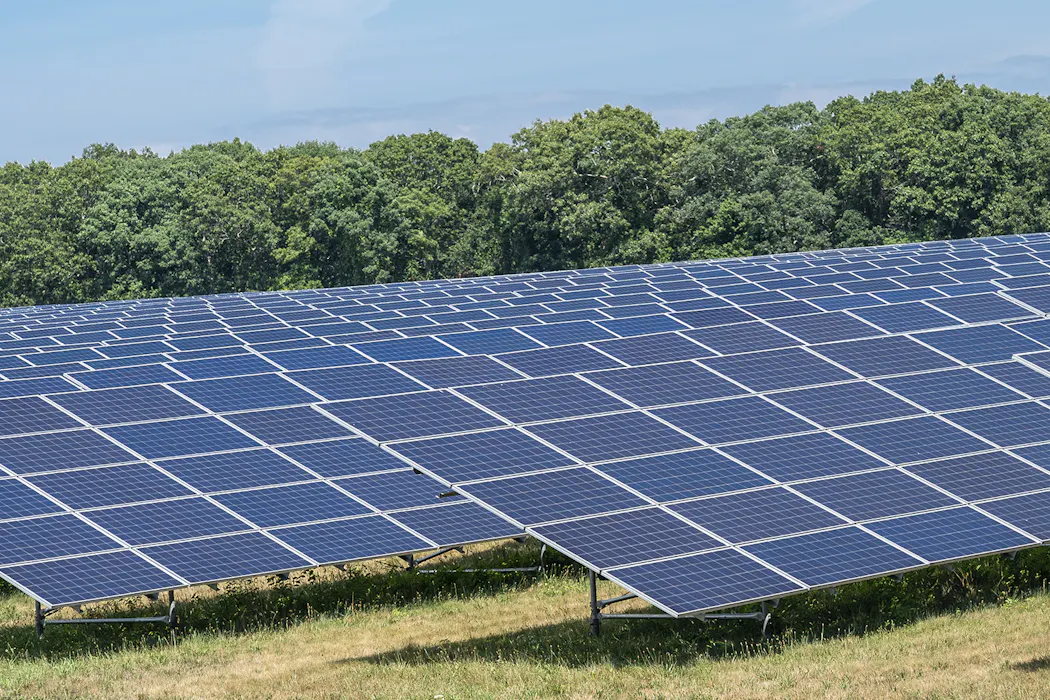
Large-scale solar power plants are key elements of energy policies in New York and other states. Lev Radin/Pacific Press/LightRocket via Getty Images The state of New York could meet its goal of building 46 gigawatts of large-scale solar by midcentury, but not without making difficult choices in how land is used across the state. That’s the overall finding of an analysis several colleagues and I have made in that state. It’s an issue that other states, and the U.S. as a whole, are facing as they seek to shift electricity generation from fossil fuels to renewable sources, such as wind and solar. The question of land use arises because power plants that burn coal and natural gas can produce l…
Why good news?
Demonstrates that renewable energy goals are technically achievable while promoting thoughtful, balanced land-use planning that considers both climate action and agricultural/conservation needs.
Why it matters?
Critical for climate action, this research guides policymakers in balancing renewable energy expansion with agricultural productivity and ecosystem preservation—a challenge relevant to all states and countries.
Read in Pusulam
Full text
Large-scale solar power plants are key elements of energy policies in New York and other states. Lev Radin/Pacific Press/LightRocket via Getty Images The state of New York could meet its goal of building 46 gigawatts of large-scale solar by midcentury, but not without making difficult choices in how land is used across the state. That’s the overall finding of an analysis several colleagues and I have made in that state.
S. as a whole, are facing as they seek to shift electricity generation from fossil fuels to renewable sources, such as wind and solar. The question of land use arises because power plants that burn coal and natural gas can produce large amounts of electricity from relatively small areas of land – but solar requires more space to generate the same amount of electricity.
That means deciding which land to build on, and why. It’s often convenient to build solar projects in pastures and hay fields , for instance. But the dairy industry and agriculture more generally are key components in New York state’s economy , and building in agricultural areas would leave less land for those important industries.
However, protecting farmland could lead solar developers to consider using existing forests. Yet forests not only soak up carbon dioxide from the atmosphere, helping reduce the effects of fossil-fuel emissions that are changing the global climate, but also support biodiversity by providing important habitat for wildlife. Basically, deciding to prioritize one type of land use means shifting that amount of development pressure to land now being used for other purposes.
As a geographer , I study these trade-offs and their inherent tensions to better understand how to determine the best way to use a particular piece of land to reduce carbon emissions. One of the primary obstacles to building more large-scale solar is the drawn-out debate over where to put it. Typical decision-making factors include farmland loss, wildlife habitat, rural landscapes and who ultimately uses the energy.
The results will determine who benefits from the expansion of renewable energy and who bears the ecological and social costs. , with nearly 397 gigawatts waiting to come on line as of 2025. Of that, 70 gigawatts of generating capacity is expected to come on line in 2026 and 2027 – on top of the nearly 148 gigawatts operating at the end of 2025.
This represents progress toward reducing carbon emissions but also requires vast tracts of repurposed land. 24 megawatts per acre . Therefore, the 70 gigawatts of solar energy expected to come on line in the next two years will require just over 320,000 acres of land, or about 242,424 football fields, about 53% of which is expected to displace farmland.
Additionally, those projects are expected to replace roughly 22,000 acres of forest and just under 10,000 acres of wetlands. Dual-use alternatives Energy, agriculture and conservation don’t have to be mutually exclusive uses of land. Instead, land can be managed more efficiently by integrating multiple uses, commonly referred to as colocation.
Grazing livestock or growing crops underneath or between rows of raised solar panels, known as agrivoltaics , is one way to keep land available for agriculture while also generating electricity. Another approach, known as ecovoltaics , involves designing solar projects to equally support renewable energy and ecosystem services , such as providing habitat for pollinators or reducing evaporation in stressed arid ecosystems. Another emerging alternative involves solar panels that are constructed to float on water rather than being mounted on land.
These approaches won’t work everywhere, but they demonstrate that, with careful thought, more renewable energy doesn’t have to hurt the environment. Specific project proposals, evaluations by local planning boards and input from the public can consider more than the costs and electricity generated from new projects. They can also take into account how plants and animals will be affected and the degree to which the land use really must change to accommodate the addition of solar panels.
S. as a whole, seeks to achieve renewable energy goals to help fight climate change, I believe discussions will be more productive if they expand beyond just how much generating capacity can be built, but where and how it is constructed. Adam Gallaher does not work for, consult, own shares in or receive funding from any company or organization that would benefit from this article, and has disclosed no relevant affiliations beyond their academic appointment.
Can we successfully balance renewable energy expansion with agricultural and conservation needs?
Pusulam AI
Chat with this story
Ask for a summary, why it matters, or missing context.
Source
This story is available in-app because its republishing terms allow it. The original source is always linked below.
Read at source →