Most Americans broadly support public education for undocumented students – regardless of their political affiliation and religion
Pusulam brief
Research shows that most Americans across political and religious lines support public education access for undocumented immigrant children. The 1982 Supreme Court decision in Plyler v. Doe established that all immigrant students have the right to free public education regardless of citizenship status.
Education is fundamental for immigrant children's integration into society. Legal protection combined with broad public support strengthens the sustainability of this right.
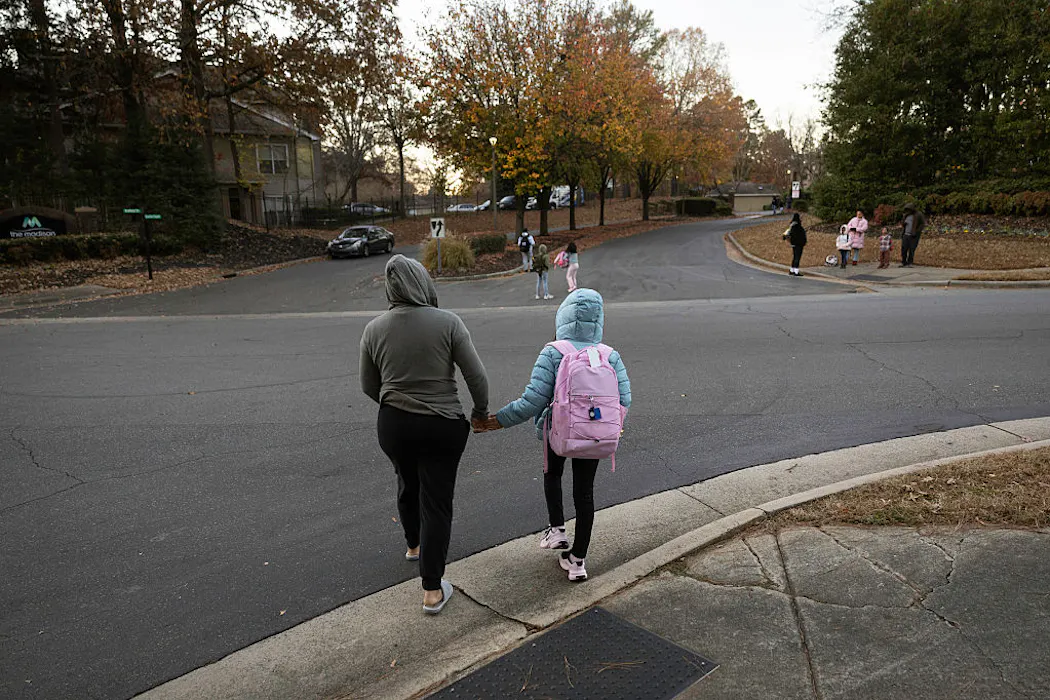
An undocumented Honduran immigrant walks her child to a school bus stop in November 2025 at an unspecified location in the U.S. John Moore/Getty Images All public schools in the U.S. must provide an education to all students, regardless of their immigration status. In 1982, the U.S. Supreme Court affirmed the right of immigrant students in Texas to attend school free of charge, regardless of their citizenship, in Plyler v. Doe. Texas had passed a law in 1975 that allowed public school districts to charge these students tuition, or not let them attend altogether. This law was repealed following the Supreme Court decision. As scholars of history and education, we are particularly interested i…
Why good news?
Broad consensus on education access across political divides demonstrates that inclusive policies can unite diverse groups. Expanding educational access strengthens social mobility for disadvantaged populations and builds community cohesion.
Why it matters?
Education is fundamental for immigrant children's integration into society. Legal protection combined with broad public support strengthens the sustainability of this right.
Read in Pusulam
Full text
S. S. must provide an education to all students, regardless of their immigration status.
S. Supreme Court affirmed the right of immigrant students in Texas to attend school free of charge, regardless of their citizenship, in Plyler v. Doe .
Texas had passed a law in 1975 that allowed public school districts to charge these students tuition, or not let them attend altogether. This law was repealed following the Supreme Court decision. As scholars of history and education, we are particularly interested in understanding how Americans feel about this policy, which has been in place for four decades.
Some legislators in states like Ohio, Idaho and Oklahoma have unsuccessfully tried to make it harder for immigrant students to attend public school, by proposing that all public school students must share their immigration status prior to enrolling in school. Tennessee considered a bill in 2025 and 2026 that would allow public school districts to not admit undocumented students . Though the bill passed the state Senate, it did not ultimately pass the House.
S. schools and students, such as straining schools’ funding and available resources. The conservative think tank Heritage Foundation has called on all state legislators to propose laws that would challenge undocumented students’ right to attend public schools free of charge.
But what do most Americans actually think about undocumented students attending public schools? According to our recent survey, which is in the process of publication, most Americans broadly support public education for undocumented children. All immigrant children have the right to attend public school, though there have been some state efforts to challenge this.
Tyler Russell/Connecticut Public via Getty Images Who supports public school for all? In mid-April 2026, with support from the Public Religion Research Institute – an organization that supports public scholarship on the beliefs of the American public – two colleagues and I worked with Ipsos to survey a nationally representative random sample of more than 1,500 Americans about their views on public education and immigration. It was a diverse cross section of people who held a range of political beliefs and affiliations.
” We found that there were obvious differences between survey respondents’ views, depending on their political affiliation. 7% of people agreed with the statement. 8% of survey respondents who voted for President Donald Trump agreed with the statement.
9% of Democrats did. 5% of all Americans agreeing with the statement. 5% of all Americans agreeing with the statement.
9% of non-Hispanic white people. In each income bracket, there was over 70% of support for free public education for all. 4%.
More than 77% of those making under $150,000 supported it. Those making under $25,000 a year supported it by 82%. 4%.
5%. Our survey showed that even looking at educational levels, there was little difference, with every group supporting public education for all students at 73% or more. Across a range of faiths, people tended to support public education for all students, including undocumented immigrants.
6% of mainline Protestants supported the idea of undocumented students attending school for free. 9% agreeing with this policy. A shift in public opinion While our data shows that today there’s widespread support for immigrant kids attending public school, these attitudes have shifted over time.
We can compare these numbers with polling about past state legislation, such as California’s Proposition 187, which passed in 1994 . Almost 60% of the state voted that year to bar undocumented students from public education. A federal court struck down the law in 1998 as unconstitutional.
While little other public polling exists showing how people feel about the Supreme Court’s Plyler ruling, there is data on a related question about undocumented immigrants who came to the country as children, often known as Dreamers. There seems to have been a shift since the ‘90s in public opinion toward supporting undocumented students. Much of this may have been due to the strong advocacy of Dreamers themselves .
S. as young children without legal authorization should be allowed to legally stay in the country. , while 54% of Republicans said the same.
5%, Republicans’ support for public education for undocumented children might seem low. However, it does correlate with other recent polling from the University of Massachusetts-Amherst that shows 91% of Republicans support Trump’s overall immigration policies. Even as political parties may play a role influencing views toward immigration, as a whole, Americans overwhelmingly support public education for all children.
The authors do not work for, consult, own shares in or receive funding from any company or organization that would benefit from this article, and have disclosed no relevant affiliations beyond their academic appointment.
Can broad consensus on education rights extend to other inclusive social policies?
Pusulam AI
Chat with this story
Ask for a summary, why it matters, or missing context.
Source
This story is available in-app because its republishing terms allow it. The original source is always linked below.
Read at source →